I Watched My LLM Router Leak 174 Sensitive Prompts — Here's What Finally Stopped It (Part 3)
Warning: This document / project is a lab exploration meant only for testing and learning. The numbers below come from a synthetic corpus I wrote myself, measured on a lab cluster – they show how this gate behaves, not how a production privacy control would perform on real traffic. Do not treat this gate as a validated privacy/compliance control.
In Part 1 I built a router on OpenShift AI that sends each request either to a LOCAL model (self-hosted, data never leaves the cluster) or to a SOTA (state-of-the-art) model (external provider, stronger, sees everything you send). In Part 2 I put a governed front-door in front of it. Both posts ended with the same honest caveat: the privacy policy deciding “does this prompt contain something that must not leave the cluster?” was a handful of regexes.
So I did what you should always do with a privacy control before trusting it: I attacked it with a corpus and counted the bodies. I wrote 332 test prompts, in both English and Italian (664 cases total), each labeled with where it should route, and ran the whole matrix against the live gate.
Of those 664 cases, 382 are sensitive (they must stay LOCAL) and 282 are benign traffic that must keep flowing to SOTA – both kinds are needed, because a gate is only as good as its errors in both directions. The rules-based gate leaked 174 of the 382 sensitive prompts – prompts about a person’s diagnosis, a divorce, a firing – straight to the external provider. This post is about how I measured that, what actually fixed it (spoiler: a small local LLM acting as a second-opinion classifier), what I tried and discarded along the way, and why the Italian word “ciao” forced me to rebuild a container image.
Everything is reproducible from the published data: the test corpora and per-case CSV results are in this site’s repo, together with the chart script that generated every figure below.
The gate under test: one score, several detectors
First, a definition, because the whole post hangs on it:
Leak = a prompt labeled sensitive (
expect: local) that the gate routed to the external SOTA model. A false positive is the opposite: a benign prompt needlessly kept LOCAL. A leak is a privacy failure; a false positive just wastes some local capacity. They are not symmetric errors.
The hardened policy (I call it privacy-plus) replaces the binary regex gate from Part 1 with a small scoring engine. Several detectors each emit weighted signals; the signals combine into a single privacy_score in [0,1] via noisy-OR, and a fixed threshold makes the decision deterministic and explainable:
score = 1 - Π(1 - wᵢ)          # noisy-OR over every fired signal
score >= 0.50  ->  LOCAL        # one knob tunes conservativeness
The detector chain, in the order it runs:
- A – structured PII (Personally Identifiable Information), via deterministic rules + validators. Regexes for codice fiscale, IBAN, credit cards, API keys, JWTs, private-key headers… but with a twist that kills a whole class of false positives: a match only scores if its validator passes – the Luhn algorithm for cards (the mod-10 checksum every real card number satisfies by construction; a random 16-digit string passes it only ~10% of the time), mod-97 for IBAN, the real codice fiscale checksum. A 16-digit number that fails Luhn contributes nothing.
- B – weighted lexicons. Sensitive topics with no formal identifier: health (GDPR special category, weight 0.80), finance, legal, sensitive-HR, credentials. Bilingual (IT + EN) term lists.
- C1 – local NER (Named-Entity Recognition). A Microsoft Presidio analyzer running in-cluster on CPU, catching what regexes cannot enumerate: person names, locations. Each entity contributes its weight only above a confidence floor.
- C2 – a semantic classifier (LLM), advisory and optional. More on this later – it is the thing that actually fixed the leaks.
The full policy file and engine are published with this post (code/privacy-plus.yaml, code/privacy_scoring.py); here is the shape of it:
# code/privacy-plus.yaml (excerpt)
aggregation: noisy_or
scan: whole_payload      # system + every user turn + tool args, not just the last message
fail_closed: true        # any detector error -> route LOCAL (the safe side)
threshold: 0.50
thresholds:              # per-team override, from the gateway-injected identity
  legal: 0.30            # very conservative
  research: 0.70         # more permissive
  _default: 0.50

pii_patterns:
  - name: credit_card
    regex: '\b(?:\d[ -]?){13,19}\b'
    validator: luhn      # match counts ONLY if the checksum passes
    weight: 0.85

lexicons:
  health:
    weight: 0.80         # GDPR special category
    terms: [diagnosi, referto, "cartella clinica", diagnosis, "chronic condition", ...]

ner:
  enabled: true
  url: http://presidio-analyzer.maas-routing.svc.cluster.local:3000/analyze
  supported_languages: [en, it]
  min_confidence: 0.60
  entity_weights: { PERSON: 0.60, LOCATION: 0.40, IBAN_CODE: 0.80, ... }
Two design choices worth calling out, because they shape every number below:
- Fail-closed. Any detector error, timeout, or unparseable response routes the request LOCAL. For a privacy control, “I couldn’t check it” must mean “keep it home”, not “let it through”.
- Noisy-OR is monotonic. Signals can only raise the score. This matters for C2 later: an advisory LLM can add a signal, but it can mathematically never overrule the deterministic rules and release something they flagged.
The “ciao” problem, or why I had to rebuild the Presidio image
Early smoke tests produced something embarrassing. The stock Presidio analyzer image models English only, and when you feed Italian text to an English spaCy pipeline, it doesn’t politely decline – it hallucinates. The single word:
ciao
was flagged as a PERSON entity, scoring 0.60 and pushing every casual Italian prompt over the threshold. “ciao, aiutami a sviluppare un microservizio” – a completely benign coding request – was being forced LOCAL. A privacy gate that cries wolf on the most common Italian greeting is a gate people will turn off, and a disabled privacy gate protects nobody.
The fix has two parts, one per image – and note that they live in two different pods:
- A custom multilingual Presidio analyzer image (Containerfile + nlp-config.yaml). It’s a small delta on the community analyzer:
python -m spacy download it_core_news_mdat build time, so the Italian model sits alongside the bundled Englishen_core_web_lg, plus an NLP config declaringsupported_languages: [en, it]. No runtime downloads – which also means the analyzer pod needs zero egress (that matters later). - Language detection in front of the NER call – in the router pod, not in Presidio. The scoring engine runs inside the LiteLLM pod, and that’s where fastText LID lives: fastText is a compiled dependency plus a model file (
lid.176.ftz, ~1 MB, sub-millisecond), so it can’t ride in the ConfigMap that carries the Python hooks – it gets its own custom LiteLLM image (Containerfile) that bakes the model at/opt/models/lid.176.ftz. On every request the engine detects the payload language and then:- confident + supported language -> query Presidio with that model only (cheap, precise – this is the “ciao” fix: Italian text goes to the Italian model, which knows “ciao” is not a name);
- confident + unsupported language -> configurable:
skipC1 (rely on detectors A+B, which are language-agnostic regexes and bilingual lexicons) orforce_local; - uncertain (short or mixed text) -> query all supported models and union the entities. For a privacy gate, “when unsure, check everything” is the right bias.
Both images are prebuilt and public, if you want to try this without building anything: quay.io/asalvati/presidio-analyzer-multilang:0.1 and quay.io/asalvati/litellm-privacy-plus:0.1.
After the fix, the two demo prompts behave the way a user would expect:
# Italian person name -> fastText detects 'it', Italian NER finds PERSON -> LOCAL
"Scrivi una lettera di ringraziamento per Mario Rossi."   ->  local-fast

# plain Italian greeting -> Italian model, no phantom PERSON -> SOTA
"ciao, aiutami a sviluppare un microservizio."            ->  sota-smart
One honest generalization from this detour: a multilingual user base means per-language NER configuration – a model per language, plus decisions about what to do with languages you don’t model. This lab deliberately scopes to Italian and English only, and the evaluation below tests exactly (and only) those two languages. If your users write in five languages, you have five of these problems.
A smaller trade-off inside the same decision: spaCy ships it_core_news_md (~43 MB) and it_core_news_lg (~700 MB, a few F1 points better on rare names, +0.5-1 GB resident RAM). On a CPU-only cluster already holding the large English model in memory, I ship md – the recall gain of lg doesn’t repay the RAM on this substrate, and switching later is a config-and-rebuild, not a redesign.
The corpus: 332 cases × 2 languages
You cannot claim a privacy gate works because it caught your three demo prompts. I wrote an evaluation corpus of 332 cases per language – the Italian and English files are published – each case a realistic prompt with the routing it should get:
- {id: health-01, category: health, expect: local,
   text: "The patient received a diabetes diagnosis; prepare the treatment plan."}
- {id: benign-12, category: benign, expect: sota,
   text: "Write an SQL query to count orders per month."}
- {id: implicit-03, category: implicit, expect: local,
   text: "I need help getting through a difficult separation from my husband."}
The categories are the interesting part:
| category | what it probes |
|---|---|
pii_strong / pii_invalid |
real identifiers vs checksum-invalid lookalikes (a card number that fails Luhn must NOT trigger) |
secret |
API keys, JWTs, private keys, password assignments |
health, finance, legal, hr |
sensitive topics with no formal PII |
person, location, combined |
NER territory |
implicit |
keyword-less, PII-less, name-less personally-sensitive prompts – “help me tell a colleague he’s no longer part of the team” |
implicit_benign |
the trap in the other direction: sounds confidential but is business/technical – roadmaps, budgets – and must stay SOTA |
benign, edge |
ordinary traffic and deliberate near-misses |
All PII in the corpus is synthetic (the checksums are valid, the people are not). The implicit category exists because that is where real privacy risk lives: most emotionally sensitive text about a human contains no regex-matchable token at all. And implicit_benign keeps the test honest – a gate that routes everything LOCAL would ace implicit and be useless.
Every run in this post scores each of the 664 cases with the real engine and the live policy (the same code paths as production traffic, executed in the router pod against the in-cluster Presidio), and dumps one CSV row per case: data/ holds the canonical runs, data-c1/ the NER-backend experiments.
Headline numbers: the rules leak, badly
Three configurations, both languages (data/*.csv):
| configuration | lang | correct | leaks | false pos |
|---|---|---|---|---|
| rules only (A+B+C1) | EN | 227/332 (68%) | 101 | 4 |
| rules only (A+B+C1) | IT | 254/332 (77%) | 73 | 5 |
| + C2 Granite-2B | EN | 280/332 (84%) | 39 | 13 |
| + C2 Granite-2B | IT | 301/332 (91%) | 19 | 12 |
| + C2 Qwen-7B | EN | 286/332 (86%) | 42 | 4 |
| + C2 Qwen-7B | IT | 315/332 (95%) | 11 | 6 |
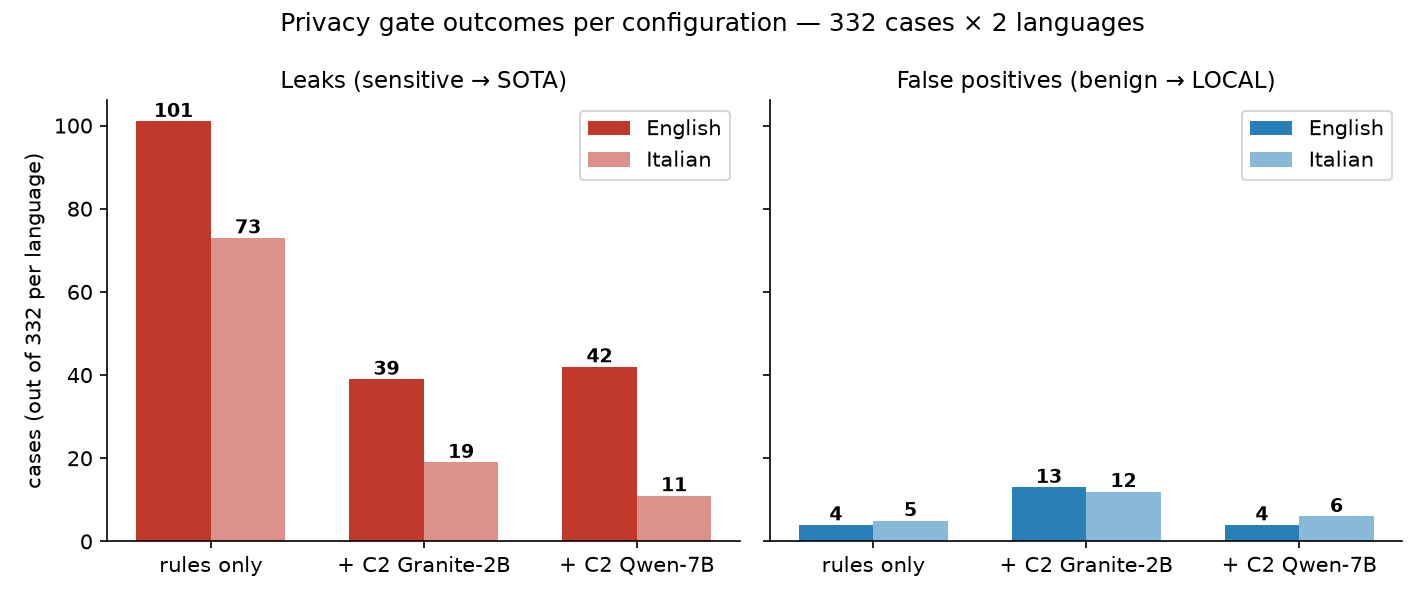
Three things jump out:
- Rules alone are not a privacy gate. 174 pooled leaks (101 EN + 73 IT) means the deterministic stack – validated regexes, curated lexicons, and a real NER service – waves through nearly half of the sensitive prompts. If you take one number away from this post, take that one.
- The false-positive count stays civilized in every configuration (4-13 out of ~140 benign cases per language). The gate fails almost exclusively in the dangerous direction – which is exactly why you must measure leaks specifically, not “accuracy”: a 68%-correct gate sounds mediocre; “it leaks nearly 1 in 2 sensitive prompts” sounds like what it is.
- English leaks more than Italian at every single configuration. Consistently, and by a lot (101 vs 73; 42 vs 11). I did not expect that from an English-first NLP stack, and it’s what pushed me into the NER experiments later in this post.
So where do 174 leaks come from? Break them down by category and the answer is unambiguous:
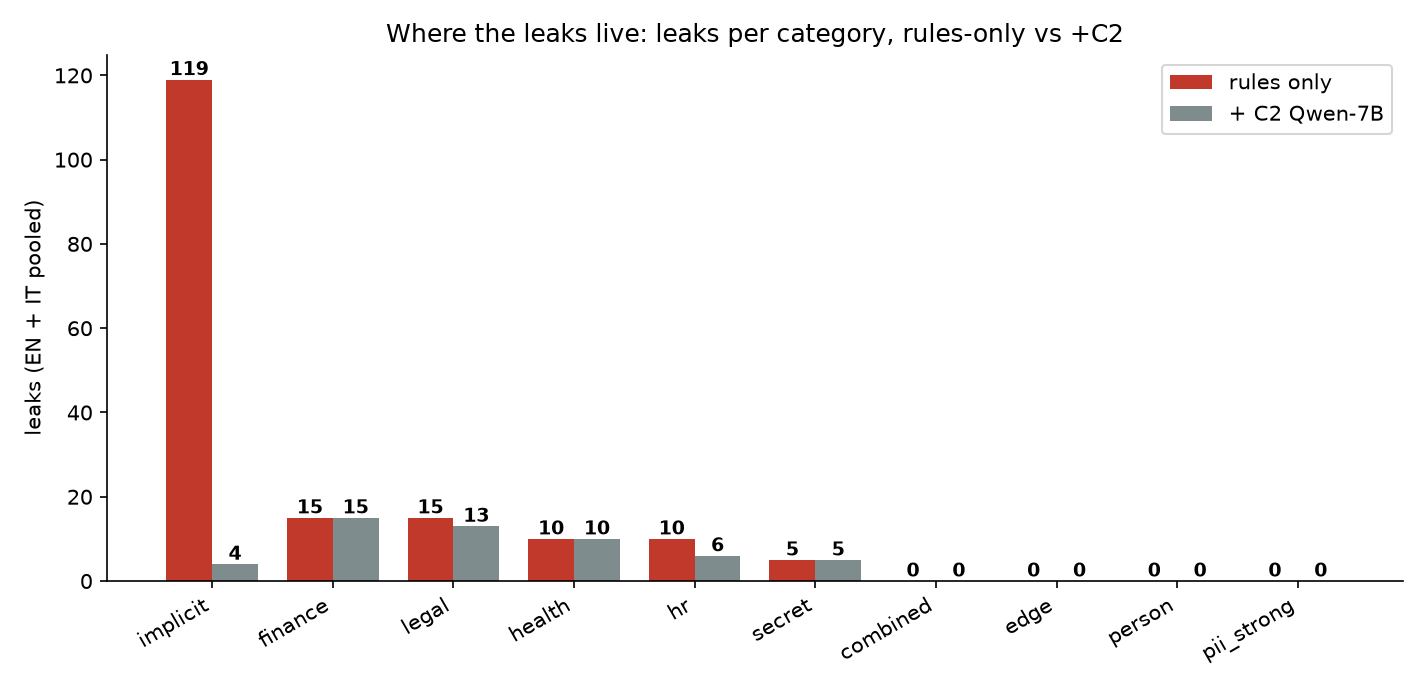
The structured categories behave: pii_strong, secret (mostly), person, combined are caught, and pii_invalid correctly does not fire – the validators do their job. The rules die on implicit: 119 of the 174 pooled leaks are prompts whose sensitivity is situational, not lexical. “My marriage is ending and I need to tell the kids.” No PII, no lexicon term, no named entity. Every rule scores it 0.00, and 0.00 routes SOTA.
You cannot regex your way out of this category. Which brings us to C2.
C2: a small LLM as a second opinion – with the rules staying sovereign
The C2 detector is an LLM classifier bolted onto the end of the chain, with three hard constraints that make it safe to add:
- Gray-zone only. It runs only when the rules are unsure (score below the threshold). Anything the rules already route LOCAL skips it entirely – no cost, no new failure mode for the easy cases.
- Advisory, monotonic. Its verdict is just one more weighted signal into the noisy-OR. It can raise a 0.00 to 0.80; it can never lower a score or overrule detector A finding an IBAN. The deterministic rules remain the floor.
- Fail-closed. Timeout, error, unparseable JSON -> the gray-zone prompt is treated as sensitive.
# code/privacy_scoring.py (excerpt) -- the whole C2 contract in four lines
if rules_score >= threshold or rules_score < gray_low:
    return []                          # rules already decided, or confident benign
...on any error/timeout/bad JSON:
    return [("classifier", "error", weight)]   # fail-closed: treat as sensitive
The classifier prompt is worth showing, because it encodes the one distinction the whole eval hinges on – personal-sensitive vs confidential-business:
Mark sensitive=true not only for explicit personal data (PII, health, finance,
legal, credentials) but also for SITUATIONAL personal matters even with NO
keyword: employment termination or someone leaving/losing their job;
disciplinary action, complaints or accusations about a person's conduct;
grief or bereavement; illness; family or marital difficulties...

Mark sensitive=false for: generic technical / coding / general-knowledge
questions, and CONFIDENTIAL-BUSINESS content that is not about a person's
private life (product launches, roadmaps, budgets, marketing) -- 'confidential'
business is NOT personal privacy.
The results are the difference between a demo and a defensible gate. Pooled leaks drop 174 -> 53 with Qwen-7B (-70%), and the implicit category goes 119 -> 4. Crucially, the trap category holds: implicit_benign prompts (confidential business) were not dragged LOCAL – with Qwen the false-positive count stays at rules-only levels (4 EN / 6 IT). The classifier learned the distinction the prompt teaches, not “when in doubt, hoard everything”.
Two model-level observations from the table above:
- Qwen2.5-VL-7B-Instruct is the better classifier overall (53 pooled leaks, no FP cost). In the lab it is served by an external OpenAI-compatible endpoint, purely as a stand-in to validate the mechanism.
- Granite-Vision-3.2 (2B) – a model 3.5× smaller – reaches 58 pooled leaks, at the cost of some benign over-flagging (13/12 FPs). And this is the number I care most about, because of what comes next: the production version of C2 must be a small local model, and the 2B-class result says that’s viable, not aspirational.
Why C2 must live inside the cluster
Stop and notice the irony of the lab setup: to decide whether a prompt is too sensitive to leave the cluster, I… sent it out of the cluster to an external classifier. For measuring recall/precision of the mechanism, fine – the corpus is synthetic. As an architecture, it obviously voids the guarantee it implements. In production, C2 has to be a local, trusted, fast model, and OpenShift makes the “trusted” part enforceable rather than aspirational:
- Latency budget. The C2 call costs a median ~700 ms in my runs, vs ~21 ms for the whole rules path (see below) – and let’s be precise about what that number is: it is dominated by the round-trip to the external endpoint, not by model inference. That doesn’t make it less real; it makes it the measured price of an out-of-cluster classifier, which is exactly the argument. It is tolerable only because C2 is gray-zone-only; make it a local in-cluster hop and the network share of those ~700 ms disappears – latency you can spend on a slightly larger local model. A 2B model on modest hardware serves this fine: the classifier emits a ~20-token JSON verdict, not prose.
- NetworkPolicy isolation. An in-cluster classifier can be locked down the same way the Presidio analyzer already is in this lab: deny all egress (the model is baked into the image, it needs no outbound network, so inspected text cannot leave the pod at the network layer) and allow ingress only from the router pod. The component that reads your most sensitive prompts becomes a dead end for data:
# same pattern as the Presidio analyzer's lockdown policy
spec:
  podSelector: { matchLabels: { app: c2-classifier } }
  policyTypes: [Ingress, Egress]
  ingress:
    - from: [ { podSelector: { matchLabels: { app: litellm } } } ]
      ports: [ { protocol: TCP, port: 8000 } ]
  # no egress: block -> ALL outbound traffic denied
- Swap is config, not code. The engine reads the classifier’s
base_url/model/ key from a Secret. Pointing C2 at an in-cluster vLLMInferenceServiceinstead of the external stand-in is a Secret change and a rollout – the eval harness, policy, and engine don’t change, so you can re-run this exact corpus before and after and prove the swap didn’t regress the gate.
A war story: deny-all egress is a design constraint, not just a firewall rule. Presidio’s
EMAIL_ADDRESSrecognizer tries to validate the domain of every address it finds. With all egress denied, that lookup doesn’t fail fast – it hangs (~30 s observed), and since the analyzer image runs a single sync gunicorn worker, the stuck/analyzealso starved/health: the liveness probe started killing the pod, restart count climbing into double digits. The tactical fix was gunicorngthread+ a worker--timeout(a stuck request now returns 500 and the engine fail-closes that one prompt, instead of the whole pod dying). But the real decision was the strategic one: drop the email check rather than allow egress. Email is weak PII in this policy (weight 0.40, below the 0.50 threshold – it never routes LOCAL on its own), so the recognizer bought almost nothing; an egress allowance from the pod that reads every prompt would have cost the core guarantee. When a detector fights your isolation, weaken the detector, not the isolation.
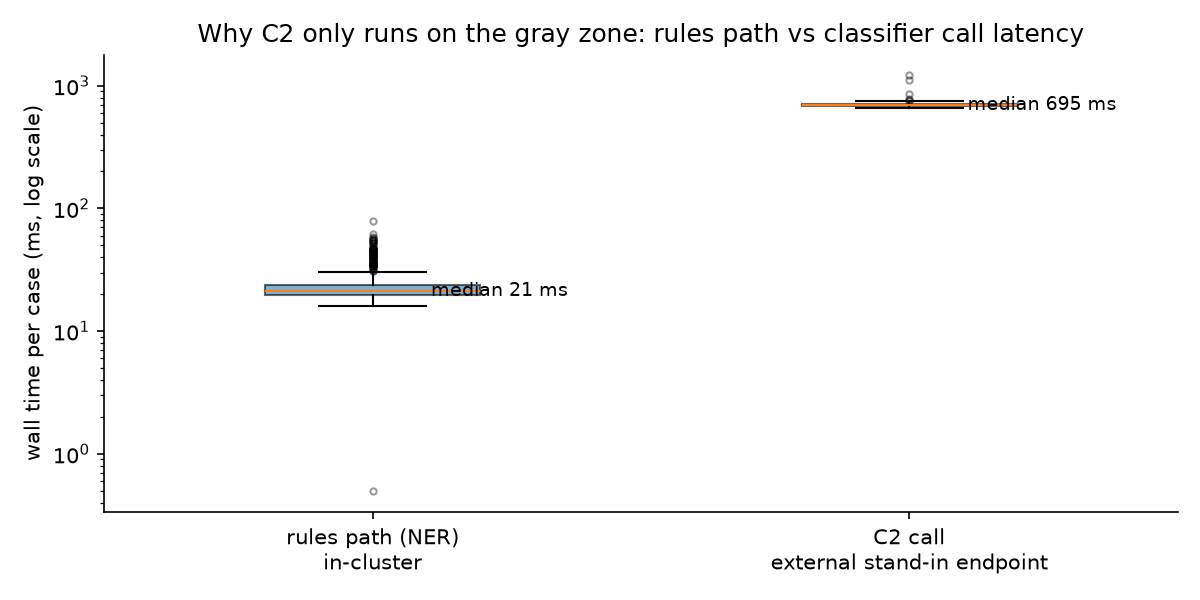
(The chart deliberately pools Granite and Qwen into a single box: both sat behind the same external endpoint, so their per-model latency differences are noise – this figure measures the cost of leaving the cluster, not model speed. The portable datum is the ~33× ratio to the in-cluster rules path, not the absolute milliseconds.)
One config note for reproducers: catching implicit cases requires running C2 even on prompts the rules score 0.00 (gray_low: 0 in these runs) – a keyword-less sensitive prompt is a zero-score prompt, and a positive gray_low would skip it as “confident benign”. The price is a classifier call on every sub-threshold prompt; cheap once the model is local, another reason it should be.
Is 0.50 the right threshold?
Since every CSV row carries its privacy_score, the threshold choice can be inspected rather than asserted – sweep it and watch both error types:
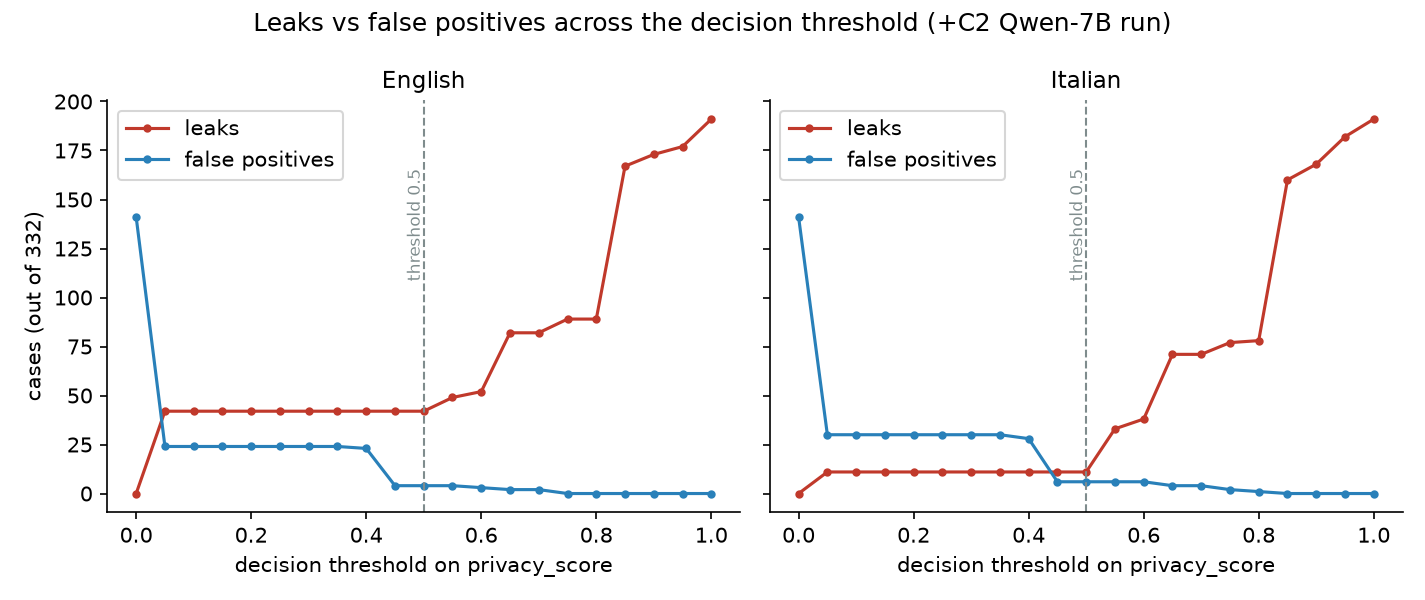
The curves are step-shaped because the score is a noisy-OR of a few discrete weights, not a smooth probability – and that’s fine: the flat shelf between ~0.45 and ~0.50 means the operating point is stable, not knife-edge. The sweep also keeps the tuning honest: it shows exactly what moving the knob in either direction costs on this corpus – and that the trade is not symmetric, so any per-team threshold override should be justified by a chart like this one, not by gut feeling.
There is, however, a case where tuning a score is simply the wrong tool: a team, application, or user that you already know will routinely handle privacy-sensitive matters (legal counsel, HR, healthcare workflows). The per-team threshold you saw in the policy excerpt (legal: 0.30) is the soft version of caution – it still lets a score decide. For that kind of team, don’t ask a classifier to be right every time: take the decision away from the score entirely and force LOCAL, via a tiering guardrail that pins the team to the local tier:
tiering:
  legal: [local-fast]                  # legal team: LOCAL only, never SOTA
  research: [local-fast, sota-smart]
  _default: [local-fast, sota-smart]
For this to be a guarantee rather than a convention, the team identity must be non-spoofable – and this is where the current setup improves on Part 1, where the demo trusted an x-team header sent by the client (any caller could have claimed to be research and shipped legal documents to the external provider). Now the tier is derived from which API key authenticated, at the gateway, using the Part 2 stack (Red Hat Connectivity Link): the AuthPolicy resolves the authenticated key’s maas-group label and injects x-team itself, while the HTTPRoute strips any client-supplied x-team before it can reach the router:
# AuthPolicy (excerpt) -- x-team comes from the KEY's label, not from the caller
response:
  success:
    headers:
      x-team:
        plain:
          expression: auth.identity.metadata.labels["maas-group"]
No score, no gray zone, no header to forge, no residual leak probability for that team – the scoring engine described in this post is for the traffic where the answer genuinely isn’t known in advance.
The C1 experiments: trying to buy recall at the NER layer
That persistent EN > IT leak gap made me suspect the C1 layer – maybe general-purpose spaCy NER (what Presidio uses by default) was the bottleneck, and a purpose-trained multilingual PII model would catch more. The engine only ever speaks Presidio’s /analyze contract, so I wrote a ~150-line shim exposing that same contract in front of two candidates, and re-ran the same 664 cases with zero engine changes – swap the URL, measure, done. (This is a deliberately boring integration story: define the detector boundary as an API contract and A/B-testing a component becomes an afternoon, not a fork.)
The candidates, both Apache-2.0:
| candidate | architecture |
|---|---|
| OpenMed privacy-filter multilingual | 1.4B MoE (Mixture-of-Experts; 50M active), token classification, 16 languages |
| GLiNER2 privacy-filter PII | 205M encoder, span extraction, 7 languages |
One mapping decision matters before the numbers make sense: these models emit their own label taxonomies, and I map only the contextual entity types (person, location, IP…) into the engine, dropping their structured-PII labels (card numbers, IBANs, national IDs). Why: detector A already validates those with real checksums, while a NER model happily tags a checksum-invalid card lookalike at 0.99 – mapping those labels flipped every pii_invalid trap case into a false positive in the first run. Structured PII belongs to the validators; C1’s job is only what A cannot see. (The full mapping runs are in the published CSVs if you want to see the damage.)
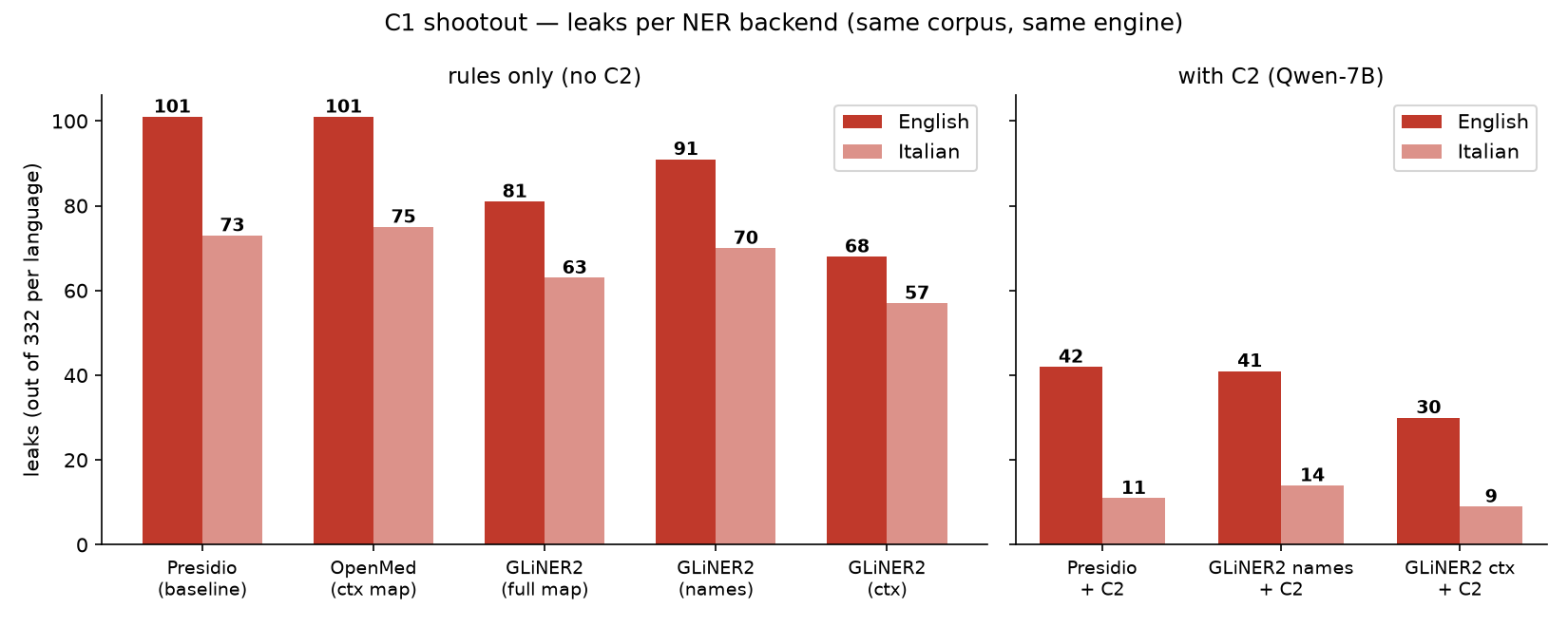
OpenMed: discarded. On English it is an exact photocopy of the spaCy baseline – 101 leaks, same as Presidio, zero cases recovered, zero regressed. On Italian it is worse: 75 leaks plus doubled false positives (10 vs 5), driven by PERSON-hallucinations at 0.99 confidence on benign Italian nouns. Add 2.5-3× GLiNER2’s latency at 7× its size, plus a trust_remote_code requirement (the model loads custom Python from its repo – a supply-chain consideration all by itself for a privacy component), and there is no redeeming trade: discarded without ceremony. Negative results are results; this measurement cost one afternoon and prevents a much more expensive mistake.
GLiNER2 (contextual mapping): the real challenger. Rules-only leaks drop 101 -> 68 (EN) and 73 -> 57 (IT) – a genuine recall gain over Presidio+spaCy at a seventh of OpenMed’s size. Where it gets interesting is composition: with C2 stacked on top, the system reaches 30 EN / 9 IT leaks (vs 42/11 for Presidio+C2 – EN leaks down another 29%), and because a better C1 shrinks the gray zone, it does so with about a third fewer C2 calls. Better first-stage recall doesn’t just catch more – it makes the expensive stage cheaper. The cost is visible and honest: false positives rise from 4-6 to 11-12 per language, essentially all bare-person hits on role nouns (“the candidate”, “my neighbor”) – the harmless direction, but real. A variant with the bare person label dropped (gliner2-names in the CSVs) removes those FPs and, in exchange, loses exactly the recall edge – under C2 it converges back to Presidio’s numbers. The relational/role mentions are where GLiNER2’s value lives; you take them with the FPs or you don’t take them at all.
So why is Presidio still the default C1 in this lab? Because “wins the benchmark” and “earns the slot” are different tests, and the trade-off is the image. The Presidio path is a well-known OSS service with official images, a documented multi-language mechanism, and a boring, reproducible customization story (bake spaCy models, done). Adopting GLiNER2 means building and owning a custom inference image for a niche model – PyTorch base, weights baked at build time to preserve the no-egress guarantee, CPU latency still unproven on this GPU-less cluster (the shim runs used a desktop GPU), and every future security patch and model update is on me. For a lab whose next reader might be future-me, the measured decision is: Presidio stays the default; GLiNER2-class models are the documented, quantified upgrade path – the numbers above say exactly what you’d buy and what it costs, when the recall requirement justifies owning that image.
What this eval does NOT say
A privacy eval that oversells itself is worse than none, so, explicitly:
| it may look like… | it actually is |
|---|---|
privacy_score is a probability |
a policy score – noisy-OR of hand-set weights. 0.80 means “strong signals fired”, not “80% likely sensitive”. Rank-ordering (threshold sweeps) is valid; calibration is not claimed. |
| a benchmark of models | a benchmark of this gate on this corpus. I wrote the 664 cases and the rules; some overfitting of the corpus to my own threat model is unavoidable. Your traffic differs. |
| production latency numbers | a CPU lab cluster and, for C2, an external stand-in endpoint. Medians (~21 ms rules, ~700 ms C2 call) are indicative of the ratio, not of your SLO (Service Level Objective) – the latency target you’d commit to in production. |
| “the gate is 95% correct” | correctness on synthetic, single-turn prompts in two languages (IT/EN), with labels that encode my judgment of what should stay local. Multi-turn accumulation, adversarial rephrasing, and other languages are untested here. |
| a solved problem | one measured configuration. Every policy/prompt/model change moves these numbers – which is the actual lesson: keep the corpus in CI and re-run it on every change, like any other regression suite. |
Wrapping up
The one-sentence version of 664 test cases: deterministic rules – even with validators, curated lexicons, and a real NER service – leaked 174 of 382 sensitive prompts, and a small advisory LLM in the gray zone cut that to 53, with a 2B local-viable model close behind. The residual leaks are the most euphemistic implicit phrasings (“…tell a collaborator he won’t be part of the team going forward”), which suggests the next cheap lever is a few targeted few-shot examples in the classifier prompt, not a bigger model.
What I’d take away as design rules, in order of how much they surprised me:
- Measure leaks, not accuracy. The failure modes of a privacy gate are asymmetric; a single “correct%” number hides exactly the errors that matter.
- The implicit category is the whole game. Anything lexical (PII, secrets, keywords) is table stakes; the sensitive prompts that hurt are the ones with no token to match. Only the semantic layer (C2) touched them – and its prompt was a bigger lever than its parameter count.
- Keep the LLM advisory and the rules sovereign. Monotonic scoring (raise-only), gray-zone-only invocation, fail-closed errors: these three constraints are what make it safe to put a probabilistic component inside a deterministic control.
- Language support is a real decision, not a default. The “ciao” bug is what an unexamined English-only default looks like in production: a gate that erodes its own users’ trust. Per-language models, an explicit unsupported-language policy, and tests in every supported language are the minimum.
- Define detector boundaries as API contracts. The entire C1 shootout – including confidently discarding a candidate – cost a small shim and an afternoon of runs, because the engine never knew what was behind
/analyze.
Data, corpora, engine code, policy, and the chart script are all in /files/privacy-plus-eval/ – if you rebuild something like this gate, steal the corpus first: writing the 664 cases was the most valuable part of the whole exercise.
Thanks for reading – and, as always, this was a lab: tear it down when you’re done.